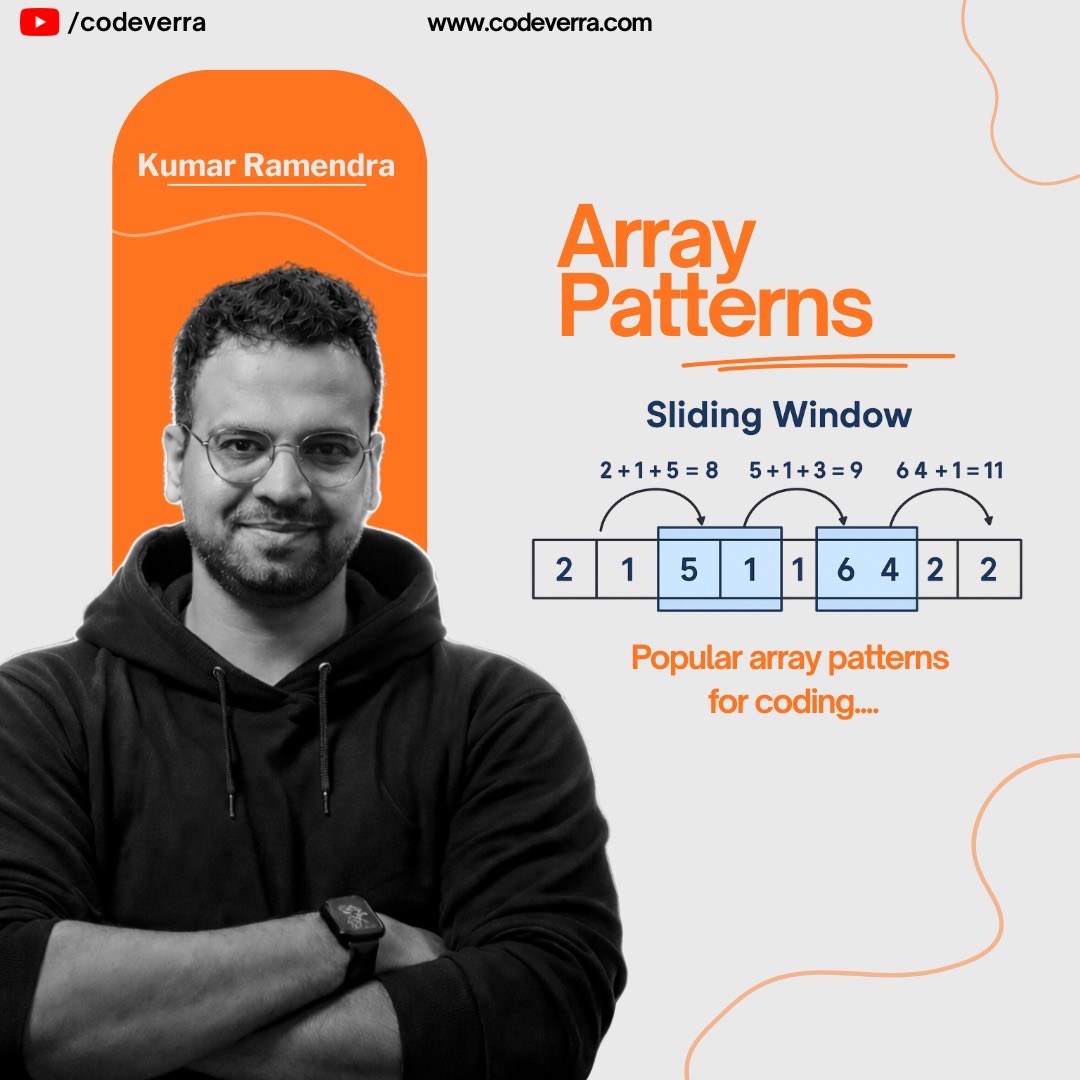
Array patterns are recurring problem-solving techniques used to solve a wide variety of array problems efficiently.
Instead of memorizing individual solutions, understanding these patterns helps you recognize how to approach a problem and design an optimal solution.
1. Traversal Pattern
Concept
The traversal pattern involves visiting each element of the array once or in a fixed manner.
When to Use
- Finding maximum or minimum elements
- Printing all elements
- Counting frequency
- Simple condition checks
Explanation Example
Traverse the array from the first element to the last, updating the required result as you move forward.
Time Complexity
O(n)
2. Sliding Window Pattern
Concept
The sliding window pattern processes a fixed-size or variable-size window that slides over the array, avoiding repeated computation.
When to Use
- Subarray sum problems
- Maximum or minimum in a window
- Longest or shortest subarray problems
Explanation Example
Instead of recalculating the sum for every subarray, update the window by adding the next element and removing the previous one.
Time Complexity
O(n)
3. Two Pointer Pattern
Concept
The two pointer pattern uses two pointers that move through the array, either from both ends or in the same direction.
When to Use
- Sorted arrays
- Pair sum problems
- Removing duplicates
- Reversing arrays
Explanation Example
One pointer starts at the beginning and another at the end. Based on conditions, one of the pointers is moved inward.
Time Complexity
O(n)
4. Prefix Sum Pattern
Concept
The prefix sum pattern precomputes cumulative sums so that range queries can be answered efficiently.
When to Use
- Range sum queries
- Subarray sum problems
- Performance optimization scenarios
Explanation Example
Store cumulative sums in an auxiliary array where each index represents the sum of elements up to that index.
Time Complexity
Preprocessing: O(n)
Query: O(1)
5. Kadane’s Algorithm (Maximum Subarray)
Concept
Kadane’s algorithm is a Dynamic Programming technique used to find the maximum sum of a contiguous subarray.
When to Use
- Maximum sum subarray problems
- Problems involving contiguous segments
Explanation Example
Maintain a running sum and reset it whenever it becomes worse than starting fresh from the current element.
Time Complexity
O(n)
6. Frequency Count Pattern
Concept
This pattern uses extra space, such as an array or hashmap, to count the frequency of elements.
When to Use
- Detecting duplicates
- Anagram checking
- Majority element problems
Explanation Example
Traverse the array and update a frequency record for each element encountered.
Time Complexity
O(n)
7. Sorting-Based Pattern
Concept
Sorting the array first can simplify the logic of many problems.
When to Use
- Pair or triplet problems
- Merging intervals
- Duplicate handling
Explanation Example
After sorting, elements that satisfy conditions often appear next to each other, reducing problem complexity.
Time Complexity
O(n log n)
8. Binary Search on Arrays
Concept
Binary search repeatedly divides the search space into half to efficiently locate elements or answers.
When to Use
- Sorted arrays
- Search problems
- Optimization problems such as binary search on answer
Explanation Example
Compare the middle element with the target and eliminate half of the array in each step.
Time Complexity
O(log n)
9. Subarray Pattern
Concept
This pattern deals with problems involving continuous segments of an array.
When to Use
- Subarray sum problems
- Longest or shortest subarray problems
- Zero-sum subarray problems
Key Insight
Sliding window or prefix sum techniques are often applied to solve these problems efficiently.
10. In-Place Modification Pattern
Concept
The in-place modification pattern updates the array without using extra space.
When to Use
- Removing elements
- Rearranging arrays
- Memory-constrained problems
Explanation Example
Use an index to overwrite unwanted elements while traversing the array.
Time and Space Complexity
Time complexity: O(n)
Space complexity: O(1)
Summary of Array Patterns
Traversal Pattern
Use case: Basic operations
Sliding Window Pattern
Use case: Subarrays
Two Pointer Pattern
Use case: Sorted arrays
Prefix Sum Pattern
Use case: Range queries
Kadane’s Algorithm
Use case: Maximum subarray
Frequency Count Pattern
Use case: Duplicates and counting
Sorting-Based Pattern
Use case: Simplifying logic
Binary Search Pattern
Use case: Fast searching
Subarray Pattern
Use case: Contiguous segments
In-Place Modification Pattern
Use case: Space optimization
Key Learning Advice
- Identify array constraints
- Check whether the array is sorted
- Look for subarray or pair conditions
- Try to reduce nested loops
- Think in terms of patterns, not individual problems
Conclusion
Mastering array patterns significantly improves your problem-solving ability.
Once you recognize the underlying pattern, designing an efficient solution becomes much easier and faster.