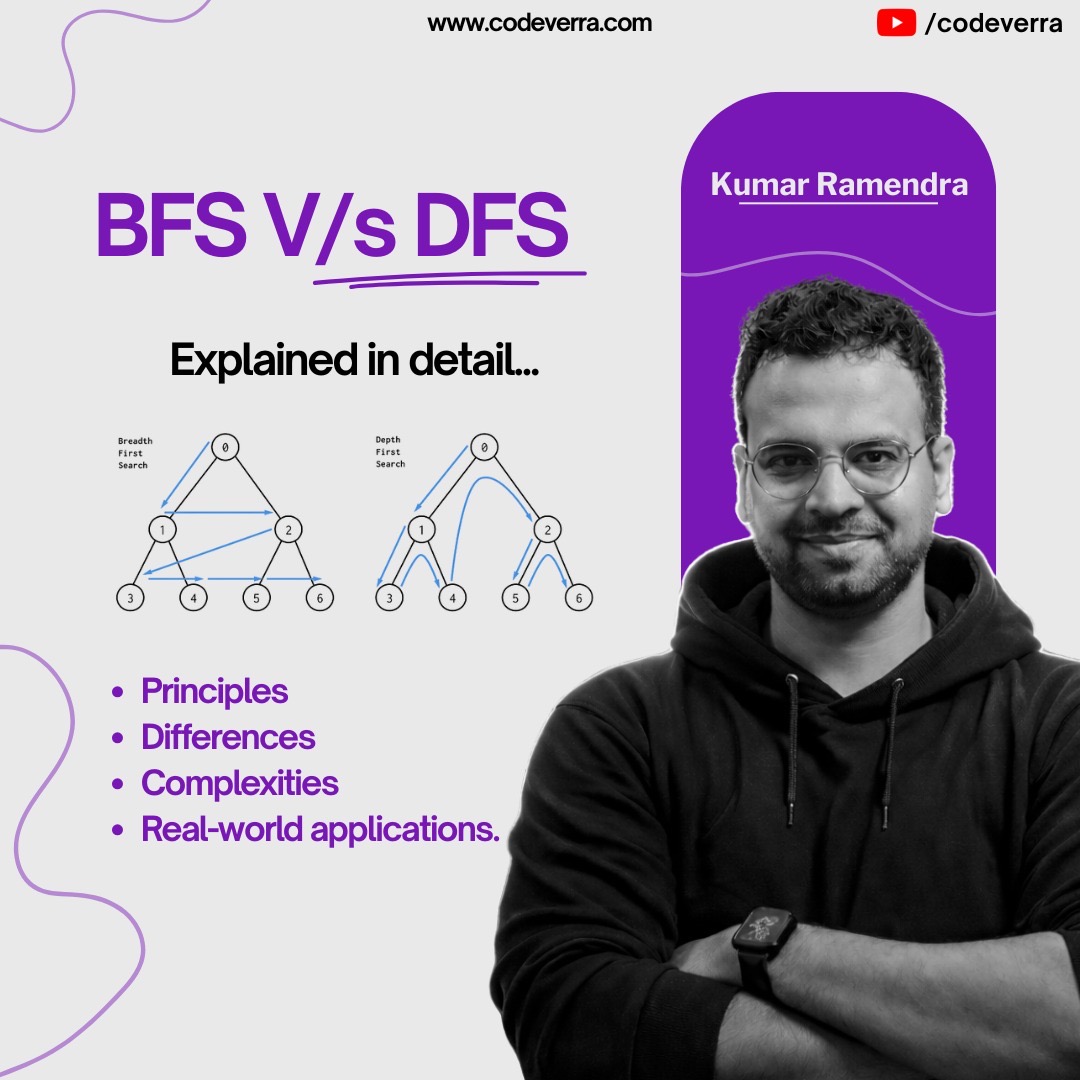
Graphs and trees are non-linear data structures. To process or explore them, traversal algorithms are used.
The two most important traversal techniques are:
- Breadth-First Search (BFS)
- Depth-First Search (DFS)
Both algorithms visit all nodes in a graph or tree, but their strategies and use-cases differ significantly.
1. Breadth-First Search (BFS)
Concept
Breadth-First Search explores a graph level by level.
It visits all neighbors of a node before moving deeper into the graph.
In simple terms, BFS explores nodes in increasing order of distance from the starting node.
How BFS Works
- Start from a source node
- Visit the node and mark it as visited
- Visit all its immediate neighbors
- Then visit neighbors of neighbors
- Continue until all reachable nodes are visited
Data Structure Used
Queue
Why Queue Is Used
BFS follows the First In, First Out (FIFO) principle.
Nodes discovered earlier are processed first, ensuring level-wise traversal.
BFS Example (Step-by-Step)
Graph structure:
A connected to B and C
B connected to D
Starting from node A:
- Visit A, queue contains A
- Visit B and C, queue contains B and C
- Visit D, queue contains C and D
Traversal order becomes:
A → B → C → D
Time Complexity
Time complexity of BFS is O(V + E)
Where:
- V is the number of vertices
- E is the number of edges
Each vertex and edge is processed once.
Space Complexity
Space complexity is O(V)
This is because the queue and visited structure may store all vertices.
Applications of BFS
- Finding shortest path in unweighted graphs
- Level-order traversal of trees
- Finding minimum number of steps
- Social networks (degrees of connection)
- Web crawling
2. Depth-First Search (DFS)
Concept
Depth-First Search explores a graph by going as deep as possible before backtracking.
In simple terms, DFS explores one complete path before trying another path.
How DFS Works
- Start from a source node
- Visit a neighbor
- Continue visiting deeper neighbors
- When no unvisited neighbor exists, backtrack
- Repeat until all nodes are visited
Data Structure Used
Stack
This can be:
- An explicit stack
- Or an implicit recursion stack
Why Stack Is Used
DFS follows the Last In, First Out (LIFO) principle.
The most recently visited node is explored first.
DFS Example (Step-by-Step)
Graph structure:
A connected to B and C
B connected to D
Starting from node A:
- Visit A
- Go to B
- Go to D
- Backtrack
- Visit C
Traversal order becomes:
A → B → D → C
Time Complexity
Time complexity of DFS is O(V + E)
Same as BFS.
Space Complexity
Space complexity is O(V)
This is due to the recursion stack or explicit stack used during traversal.
Applications of DFS
- Cycle detection
- Topological sorting
- Finding connected components
- Path existence problems
- Solving mazes and puzzles
- Backtracking problems
3. Key Conceptual Differences
Traversal Strategy
BFS explores breadth first.
DFS explores depth first.
Data Structure
BFS uses a queue.
DFS uses a stack or recursion.
Shortest Path
BFS guarantees the shortest path in unweighted graphs.
DFS does not guarantee the shortest path.
4. BFS vs DFS Comparison
Traversal Style
BFS: Level-wise
DFS: Depth-wise
Data Structure
BFS: Queue
DFS: Stack or recursion
Shortest Path
BFS: Yes (for unweighted graphs)
DFS: No
Memory Usage
BFS: Higher
DFS: Lower
Implementation
BFS: Iterative
DFS: Recursive or iterative
Use Case
BFS: Minimum distance problems
DFS: Exhaustive search problems
5. When to Use BFS vs DFS
Use BFS When
- You need the shortest path
- Distance or level matters
- The graph is unweighted
- You are searching for the nearest solution
Use DFS When
- You need to explore all possibilities
- Memory is limited
- Solving puzzles or backtracking problems
- Detecting cycles or connectivity
Conclusion
Breadth-First Search and Depth-First Search are foundational graph traversal algorithms.
Understanding their traversal strategies, data structures, complexities, and use-cases is essential for solving graph problems efficiently in interviews and real-world applications.