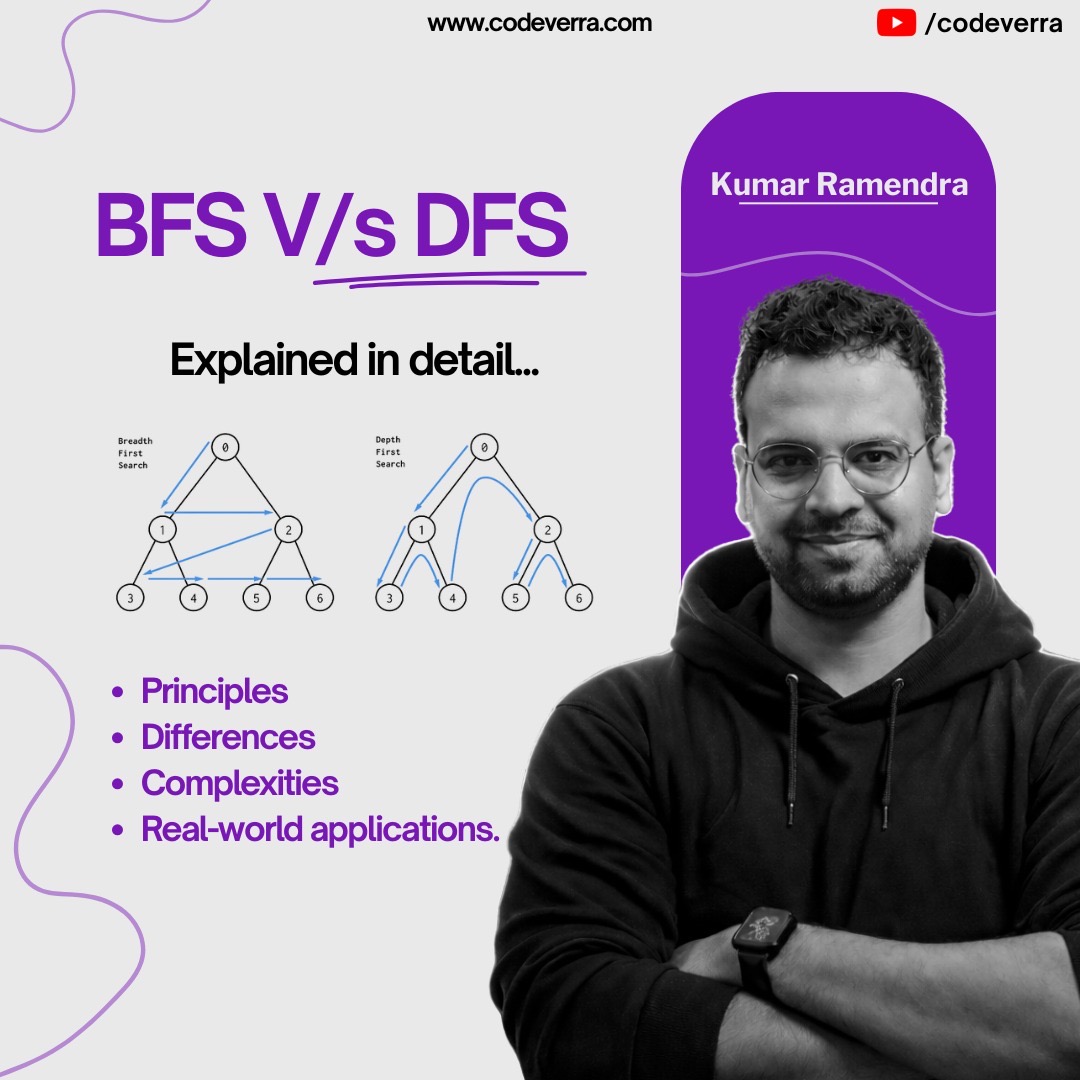
Data Structures and Algorithms (DSA) are often treated as a necessary evil, something you grind through only to clear technical interviews. This narrow framing has done more harm than good. It leads to shallow learning, memorized solutions, and frustration when problems slightly change. The truth is simple: DSA is not just about interviews. It is about learning how to think clearly, reason about efficiency, and design solutions that scale. This blog lays out: Why DSA matters beyond interviews - How to approach DSA learning the right way - A structured roadmap of topics and patterns - Practical guidance on how to practice effectively - This is not a problem list. It is a thinking roadmap. --- ## Why Study DSA Beyond Interviews ### 1. DSA Builds Strong Problem-Solving Skills At its core, DSA teaches you how to: Break a complex problem into smaller parts Identify constraints and edge cases Choose the right representation for data Reduce unnecessary complexity Good data structures simplify logic. Poor choices complicate even simple tasks. This habit of structured thinking carries into every area of software engineering. ### 2. DSA Helps You Write Efficient and Scalable Code Efficiency is not about premature optimization. It is about avoiding obvious inefficiencies. Understanding algorithms helps you: Recognize when a solution will not scale Make informed trade-offs between time and space Avoid brute-force approaches that fail on large inputs Even with powerful hardware and high-level languages, algorithmic thinking still matters. ### 3. DSA Improves Debugging and Code Reviews When you understand how an algorithm works internally: You can mentally trace execution You spot logical flaws faster You understand why certain edge cases fail This makes debugging less about trial and error and more about reasoning. ### 4. DSA Is the Foundation for Advanced Topics Many advanced concepts are built directly on DSA fundamentals: DSA Concept Real-World Applications Trees Databases, file systems, indexing Graphs Networks, dependencies, schedulers Heaps Priority queues, streaming systems Dynamic Programming Optimization problems Hashing Caching, fast lookups DSA is not isolated knowledge. It is the foundation layer. --- ## How Most People Learn DSA (And Why It Fails) ### Common mistakes: Solving random problems without a plan Jumping to hard problems too early Memorizing solutions instead of understanding patterns Ignoring time and space complexity Skipping recursion and fundamentals This approach creates the illusion of progress but fails under pressure. A structured roadmap fixes this. --- ## How to Start Learning DSA the Right Way Before starting DSA, you should be comfortable with: One programming language (Python is a great choice) Variables, loops, conditionals Functions and basic recursion Language confidence matters more than rushing into algorithms. --- ## Complete DSA Learning Roadmap (Structured) ### 1. Core Foundations (Mandatory Before Everything Else) | Area | Topics to Cover | Why It Matters | | ---------------------- | ----------------------------------------- | ---------------------------------------- | | Programming Basics | Variables, loops, conditionals, functions | DSA logic fails without language fluency | | Problem Constraints | Input size, limits, edge cases | Drives algorithm choice | | Time Complexity | Big-O, best/average/worst case | Prevents non-scalable solutions | | Space Complexity | Auxiliary vs input space | Important for memory-heavy problems | | Recursion Basics | Call stack, base case, recursive flow | Foundation for trees, backtracking, DP | | Iteration vs Recursion | When to use which | Improves code clarity and performance | | Dry Runs | Manual tracing | Builds debugging and reasoning skills | ### 2. Linear Data Structures | Data Structure | Concepts | Key Skills Developed | | -------------- | ------------------------------------------- | --------------------------------- | | Arrays | Indexing, traversal, resizing, in-place ops | Memory awareness, iteration logic | | Strings | Character access, substrings, immutability | Text processing, pattern matching | | Linked Lists | Pointers, insertion, deletion, reversal | Pointer manipulation | | Stacks | LIFO, recursion simulation | Expression parsing, undo logic | | Queues | FIFO, circular queues | Scheduling, buffering | ### 3. Searching, Sorting, and Basic Techniques | Area | Topics | Why Important | | ---------------------- | --------------------------------------- | --------------------------- | | Searching | Linear search, binary search | Fundamental optimization | | Sorting | Selection, insertion, merge, quick | Comparison-based thinking | | Binary Search Variants | First/last occurrence, search on answer | Logarithmic problem solving | ### 3: Hashing and Prefix Techniques | Technique | Topics | Problem-Solving Value | | ------------------ | ----------------------------- | -------------------------- | | Hash Maps | Key-value storage, collisions | Constant-time lookups | | Hash Sets | Uniqueness, membership checks | De-duplication | | Frequency Counting | Counting patterns | Many array/string problems | | Prefix Sums | Range queries | Converts O(n²) → O(n) | ### 4: Two Pointer & Sliding Window Patterns | Pattern | Applied On | Why It Matters | | ------------------ | --------------------- | -------------------------- | | Two Pointers | Arrays, strings | Reduces nested loops | | Sliding Window | Subarrays, substrings | Efficient range processing | | Fast–Slow Pointers | Linked lists | Cycle detection | ### 5. Recursion and Backtracking | Concept | Topics | Core Learning | | -------------------------- | ------------------------- | ----------------------- | | Recursion Design | Base case, recursive case | Problem decomposition | | Backtracking | Subsets, permutations | Decision tree traversal | | Constraint-Based Recursion | Pruning paths | Optimization | ### 6. Trees | Tree Type | Concepts | Skills Developed | | ------------------- | ----------------------- | --------------------- | | Binary Trees | DFS, BFS, height, depth | Recursive reasoning | | Binary Search Trees | Insert, delete, search | Ordered data handling | | Tree Properties | Diameter, balance | Structural analysis | ### 7. Heaps and Greedy Algorithms | Area | Topics | Application | | --------------- | ----------------------- | ---------------------- | | Heaps | Min heap, max heap | Priority-based logic | | Priority Queues | Scheduling | Real-time systems | | Greedy Strategy | Local vs global optimum | Optimization intuition | ### 8. Graphs | Graph Topic | Concepts | Real-World Modeling | | -------------------- | --------------------- | --------------------- | | Graph Representation | Adjacency list/matrix | Data modeling | | Traversals | BFS, DFS | Reachability | | Topological Sort | Kahn’s, DFS-based | Dependency resolution | | Shortest Path | Dijkstra, BFS | Routing, latency | | MST | Prim’s, Kruskal’s | Network optimization | ### 9. Dynamic Programming | Area | Topics | Why It’s Critical | | ---------------------- | ---------------------------------- | ---------------------- | | Problem Identification | Overlapping subproblems | When DP applies | | State Definition | What uniquely defines a subproblem | Core DP skill | | Transitions | State relationships | Logic formulation | | Approaches | Top-down, bottom-up | Implementation clarity | | Optimization | Space optimization | Performance tuning | ### 10: Advanced Patterns | Pattern | Use Case | | --------------------------- | ------------------------- | | Bit Manipulation | Low-level optimization | | Union-Find | Connectivity problems | | Monotonic Stack | Range queries | | Trie | Prefix-based searching | | Segment Tree / Fenwick Tree | Range updates and queries | ## Learning playlists Here are some curated playlists you can follow: ### Python & DSA ### Leetcode with Python in Hindi #100DaysOfLeetcode --- More structured posts and learning paths coming soon.